

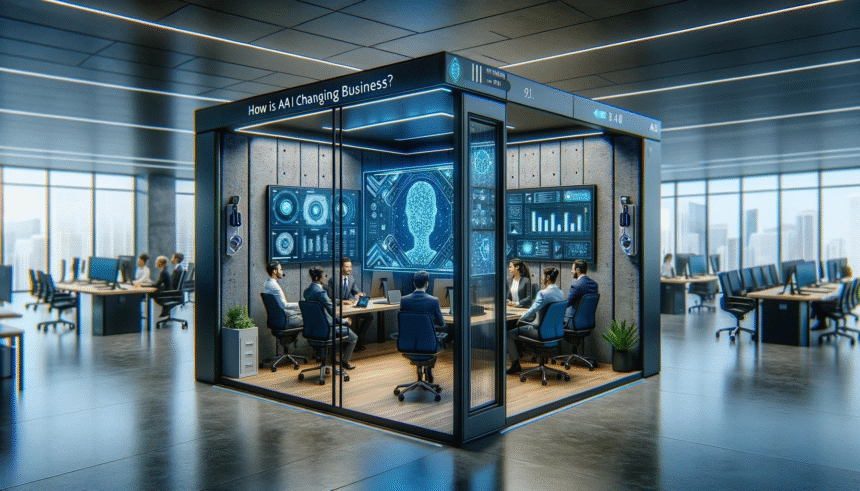
Artificial Intelligence (AI) is no longer just a futuristic idea from science fiction. It is now a real and powerful force that is changing how businesses work across the world. From small shops to large global companies, AI is being used to improve decision-making, reduce costs, increase speed, and create better customer experiences.
- 1. AI is improving decision-making in business
- 2. AI is improving customer service
- 3. AI is automating repetitive tasks
- 4. AI is transforming marketing strategies
- 5. AI is improving product recommendations
- 6. AI is helping in financial management
- 7. AI is changing human resources (HR)
- 8. AI is increasing business competition
- 9. Challenges of using AI in business
- Conclusion
- Frequently Asked Questions (FAQs)
In simple words, AI means machines and software that can “think” and “learn” like humans. They can analyze data, recognize patterns, and even make decisions without constant human help. Because of this ability, AI is transforming almost every part of business operations.
In this article, we will explore how artificial intelligence is changing business in easy and clear language, with real-life understanding.
1. AI is improving decision-making in business
Earlier, business decisions were mostly based on experience, guesswork, or basic reports. Now, AI helps companies make smarter decisions by analyzing large amounts of data in seconds.
For example, a company can use AI to understand customer buying behavior. It can show what products are popular, what customers are likely to buy next, and even when sales might increase or drop.
Instead of relying only on human judgment, businesses now use data-driven insights. This reduces mistakes and increases accuracy in planning and strategy.
In short, AI helps businesses answer questions like:
- What should we sell more of?
- When should we launch a new product?
- Which customers are most valuable?
2. AI is improving customer service
Customer service is one of the biggest areas where AI is making a difference. Many companies now use chatbots and virtual assistants to answer customer questions.
These AI tools can respond instantly, 24/7, without needing a human agent. They can handle simple questions like order tracking, refund status, or product details.
For example, when you visit a website and a chat box appears asking, “How can I help you?”, that is often AI working behind the scenes.
AI in customer service helps businesses:
- Reply faster to customers
- Reduce waiting time
- Handle thousands of customers at once
- Lower support costs
Even though AI cannot fully replace human support for complex problems, it makes the overall experience much smoother.
3. AI is automating repetitive tasks
Many business tasks are repetitive and time-consuming. These include data entry, invoice processing, email sorting, and scheduling.
AI can easily handle these tasks, allowing employees to focus on more important and creative work.
For example:
- AI can automatically sort emails into categories
- It can process bills and payments without human input
- It can schedule meetings based on availability
This automation saves time and reduces human error. It also increases productivity because workers can focus on tasks that require thinking and creativity instead of routine work.
4. AI is transforming marketing strategies
Marketing has changed a lot due to AI. Companies now use AI tools to understand customer behavior and create targeted ads.
Instead of showing the same advertisement to everyone, AI helps businesses show personalized ads based on user interests.
For example:
- If someone searches for shoes online, they may start seeing shoe ads on social media
- If someone watches cooking videos, they may see kitchen product ads
AI helps businesses:
- Identify target audiences
- Predict customer interests
- Improve advertising results
- Increase sales conversions
This makes marketing more effective and less wasteful.
5. AI is improving product recommendations
Have you ever noticed how Netflix suggests movies you might like? Or how Amazon recommends products based on your past searches? That is AI at work.
AI analyzes your behavior and suggests products or services that match your interests. This increases the chances of customers buying more.
For businesses, this is very powerful because:
- It increases customer engagement
- It boosts sales
- It improves customer satisfaction
Personalized recommendations make customers feel understood, which builds loyalty toward the brand.
6. AI is helping in financial management
Managing money is very important for any business. AI helps companies track expenses, manage budgets, and detect fraud.
For example:
- AI can analyze transactions and detect unusual activity
- It can predict future expenses based on past data
- It can help businesses plan investments wisely
Banks and financial companies use AI to identify suspicious transactions and prevent fraud before it happens.
This makes financial systems more secure and reliable.
7. AI is changing human resources (HR)
Hiring the right employees is a big challenge for companies. AI helps HR teams by sorting resumes, analyzing candidates, and even conducting initial interviews.
Instead of manually reviewing hundreds of resumes, AI can quickly shortlist the best candidates based on skills and experience.
AI also helps in:
- Employee performance tracking
- Training recommendations
- Workforce planning
This makes hiring faster and more efficient.
8. AI is increasing business competition
While AI brings many benefits, it also increases competition. Companies that use AI grow faster than those that do not.
Small businesses can now compete with larger companies by using AI tools for marketing, sales, and customer service.
However, businesses that ignore AI may fall behind because they will be slower, less efficient, and less data-driven.
9. Challenges of using AI in business
Even though AI is powerful, it also has challenges:
- High cost: Some AI systems are expensive to develop and maintain
- Job concerns: Some people worry AI will replace jobs
- Data privacy: Businesses must protect customer data carefully
- Dependence on technology: Too much reliance on AI can be risky
Companies must balance AI use with human decision-making.
Conclusion
Artificial Intelligence is changing the business world in many powerful ways. It helps companies make better decisions, improve customer service, automate tasks, and increase profits. It also makes marketing smarter, finance safer, and hiring faster.
However, AI is not meant to replace humans completely. Instead, it works best when combined with human creativity, emotion, and judgment.
Businesses that adapt to AI are likely to grow faster and succeed in the future. Those that ignore it may struggle to keep up.
In simple terms, AI is not just a tool—it is becoming a key partner in modern business success.
Frequently Asked Questions (FAQs)
1. What is artificial intelligence in business?
Artificial intelligence in business means using smart computer systems that can analyze data, learn patterns, and help companies make better decisions and automate tasks.
2. How does AI improve business efficiency?
AI improves efficiency by automating repetitive work, reducing errors, and helping employees focus on more important tasks that require creativity and strategy.
3. Can small businesses use AI?
Yes, small businesses can use AI tools for marketing, customer support, and sales. Many affordable AI tools are available today that help small businesses grow.
4. Will AI replace human jobs in business?
AI may replace some repetitive jobs, but it also creates new jobs. Most experts believe AI will work alongside humans rather than completely replace them.
5. What are the main benefits of AI in business?
The main benefits include faster decision-making, improved customer service, increased productivity, better marketing, and higher profits.